Quick answer
In Missouri, every commercial backflow prevention assembly has to be tested by a state-certified tester when it is installed and then once a year. Your water supplier sets the anniversary date, and the test is due within 30 days after it. The tester then has 30 days to file a signed report with you, the water supplier and any local authority. If the supplier still has no report 60 days after your anniversary date, it has to notify you, the local authority and the Missouri Department of Natural Resources. If a violation goes uncorrected, the supplier can shut off your water service.
Most facility managers know backflow testing is “an annual thing.” The trouble usually comes from the paperwork chain around the test: who sets the date, who files the report, and what happens to the schedule when an assembly fails. This guide follows that chain in order, using the Missouri rule and the cross-connection programs St. Louis-area buildings actually report to.
1. Your deadline is set by the water supplier, not the calendar
Under Missouri's backflow rule, 10 CSR 60-11.010, the supplier of water records the date of each assembly's first test and sets an annual anniversary date. Reduced pressure principle assemblies (RPZs) and double check valve assemblies must be tested each year by a date which is no later than thirty (30) days past the anniversary date established by the supplier of water. Air gaps are inspected on the same schedule.
What that means in practice:
- Your due date is tied to the assembly's history, not to January 1 or your lease renewal.
- A building with a domestic RPZ, a fire-line double check and an irrigation assembly can have three different anniversary dates.
- A new tenant or a new property manager inherits those dates. Ask the water supplier for them instead of guessing.
In Missouri, commercial backflow assemblies are due for testing no later than 30 days after the anniversary date set by the water supplier, and that date can differ for each assembly in the same building.
2. Which program you report to depends on your address
The Missouri rule sets the minimum. Local programs add their own steps.
- St. Louis County (Missouri American Water service area): Missouri American Water's Cross Connection Control Program requires non-residential customers to install, at their own expense, an approved containment assembly as close to the meter as practical and before any branch. Its rules say the company will refuse to continue service if an assembly isn't properly inspected, tested and maintained. Missouri American Water's new-service form says that after installation and before water service starts, the assembly must be tested by a Missouri-certified, St. Louis County-licensed tester, inspected by St. Louis County, and the report sent to the Backflow section of the St. Louis County Department of Public Works. St. Louis County's test report form must be filed within 30 days of the test, with one form per test, pass or fail.
- Municipalities inside the county: Cities like Eureka direct owners to complete the annual test and send results to St. Louis County Public Works, which also issues installation permits.
- City of St. Louis and St. Charles County communities: These have their own water suppliers (the City Water Division, Missouri American Water's St. Charles County system, or a municipal utility). The state rule still applies. Confirm the reporting address and any local license requirement with the supplier on your bill before the test.
Missouri requires annual testing statewide, but St. Louis County adds its own tester licensing and a report filed with County Public Works within 30 days.
3. What the tester actually checks
The state rule, 10 CSR 60-11.010, sets pass criteria for each assembly type.
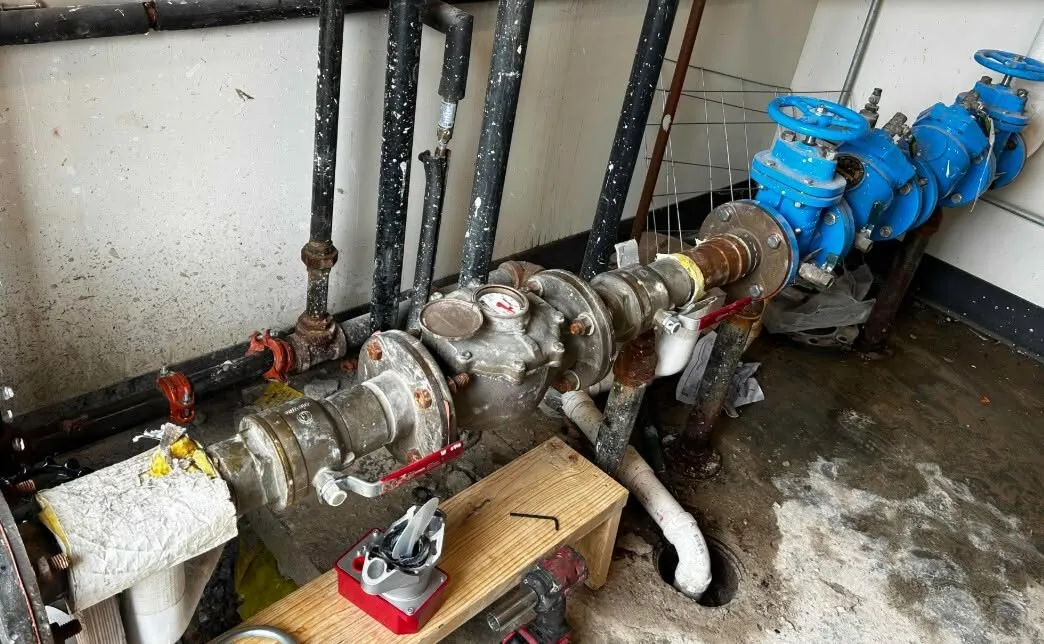
- RPZ: The relief valve must keep the zone between the checks at least 2.0 psi below supply pressure. The No. 2 check must be leak-tight against reverse flow. The pressure drop across the No. 1 check must be at least 3.0 psi greater than the relief valve's opening differential.
- Double check: Both checks must hold at least 1.0 psi in the direction of flow and be leak-tight against reverse flow.
Missouri allows only RPZs, double checks or an approved air gap as containment, and assemblies must appear on the USC Foundation for Cross-Connection Control and Hydraulic Research (FCCCHR) or ASSE approved lists, according to the Missouri Department of Natural Resources. Swapping in an unlisted device won't count as containment.
4. Why low pressure is the real-world reason this matters
Backflow happens when pressure in the public main drops below pressure inside a building. On June 30, 2026, the City of St. Louis Water Division issued a precautionary boil advisory after a pump unexpectedly tripped offline at the Chain of Rocks Water Treatment Plant and caused low water pressure, First Alert 4 reported. “Anytime pressure drops beneath 20 there's a chance that contaminants could get into the water system,” Spencer Gould, Deputy Commissioner of Water for the City of St. Louis, told the station.
On August 17–18, 2026, a power loss at the same plant during severe weather dropped pressure again and the city issued another precautionary boil advisory for parts of St. Louis. Both St. Louis events were precautionary advisories; no contamination was found and the advisories were lifted.
The EPA's Cross-Connection Control Manual explains what can happen when protection is missing: when supply pressure drops, chemicals such as antifreeze in a building's boiler or process loop can be siphoned back into the drinking water lines. A tested, working assembly is what keeps a pressure drop in the street from becoming a contamination event inside your building.
5. When an assembly fails: the sequence that keeps you compliant
A failed test is not a violation by itself. Leaving a failed assembly in service unrepaired is. The sequence that keeps you compliant:
- The tester files the failed report.
- The assembly is repaired or replaced.
- The assembly is retested and the passing report is filed.
- You keep copies of both reports. Water suppliers keep backflow records for five years, according to Missouri DNR guidance (PUB0393), and your file should match theirs.
Planning points: repairing or replacing an assembly usually means a short water outage unless the building has a parallel assembly. Scheduled service Monday–Friday, 7am–4pm. 24/7 emergency calls answered. Plan tests and repairs for scheduled weekday hours when possible. An RPZ can discharge water through its relief valve, so the location needs drainage sized for that flow, and an outdoor RPZ in an ASSE 1060 enclosure needs a drain opening that can carry the discharge.
6. Winter is a backflow season too
An outdoor assembly in an ASSE 1060 Class II enclosure relies on a heat source to stay above freezing. Before cold weather, check that enclosure heaters work, drains are clear and insulation is in place. Irrigation assemblies should be winterized, and they need to be retested when they are reinstalled in spring. Our first hard freeze walkthrough covers the rest of a building's cold-weather checks.
7. A one-page backflow file for every building
- Location, size, make, model and serial number of each assembly.
- Assembly type and what it protects (domestic, fire, irrigation, equipment).
- Water supplier and reporting authority.
- Anniversary date and due date.
- The last three test reports, with any repairs.
- Tester name and Missouri certification number.
How Legacy Plumbing helps
Legacy Plumbing installs, tests, repairs and replaces commercial backflow assemblies across St. Louis City and County, St. Charles County and Jefferson County with Missouri-certified, St. Louis County-licensed backflow testers on staff. See our backflow prevention and testing service, add assemblies to a preventive maintenance plan, pair testing with commercial water heater work, or check your due dates with the Backflow Compliance Checker.
Call 636-978-0120. Scheduled service Monday–Friday, 7am–4pm. 24/7 emergency calls answered.
Frequently asked questions
How often does a commercial backflow preventer have to be tested in Missouri?
At installation and once a year after that, by a Missouri-certified tester. The test is due no later than 30 days after the anniversary date set by your water supplier (10 CSR 60-11.010).
Who sends the backflow test report to the water company?
The certified tester does. Missouri requires the tester to send signed results to the customer, the water supplier and the local authority, if there is one, within 30 days of the test. In St. Louis County, that includes the Department of Public Works Backflow section.
What happens if I miss my backflow test?
If the supplier has no report 60 days after your anniversary date, it must notify you, the local authority and Missouri DNR. If you don't correct the violation after you're notified, the supplier must disconnect your service.
What's the difference between an RPZ and a double check?
An RPZ has a relief valve between two checks that dumps water if pressure in the zone gets too close to supply pressure. It's the highest level of mechanical protection and is used for health hazards. A double check has two checks without the relief valve and is used for lower-hazard connections. Your supplier decides which one your hazard requires.
Does a failed backflow test mean I'm in violation?
Not if you act on it. Repair or replace the assembly, retest it and file the passing report. The violation is leaving a failed assembly in service.
Sources
Missouri Code of State Regulations, 10 CSR 60-11.010, Prevention of Backflow and Back-Siphonage.
First Alert 4, St. Louis City residents stock up on bottled water after boil water advisory issued, June 30, 2026.
First Alert 4, Boil water advisory hits 26 St. Louis neighborhoods after power loss at treatment plant, August 17, 2026.
U.S. EPA, Cross-Connection Control Manual (EPA 816-R-03-002).
Missouri 10 CSR 60-11.010 (Cornell Legal Information Institute).
Missouri DNR, Backflow Prevention Frequently Asked Questions (PUB2158).
Missouri DNR, Cross Connection Identification and Backflow Prevention, Customer (PUB2940).
Missouri DNR, Basics of Missouri Backflow Regulations for Community Water Systems (PUB0393).
Missouri DNR, Backflow Prevention.
Missouri American Water, Cross Connection Control Program Regulations.
Missouri American Water, Form 1A.
City of Eureka, Annual Backflow Prevention Device Inspection.
City of St. Louis, precautionary boil advisory lifted, August 18, 2026.
ASSE 1060, outdoor enclosures for fluid-conveying components (ANSI preview).
Related services & projects
Talk to a St. Louis commercial plumber
Send drawings or a scope and we'll return a written bid within one business day.
More Resources
- Grease Interceptor vs. Grease Trap: Choosing, Sizing and Placing One on a St. Louis Restaurant Build-Out
Hydromechanical or gravity? How St. Louis City, St. Louis County and St. Charles County codes size grease interceptors, and what to settle before slab cuts.
- Legionella Water Management Plans: The Plumbing Side, Explained for St. Louis Facility Teams
What a Legionella water management plan covers, who needs one, and the plumbing work behind it: water heaters, mixing valves, recirc loops and dead legs.
- Strapped Plumbing and MSD's 2027 Rules: What St. Louis Building Owners and Builders Need to Know
MSD's 2027 draft requires strapped plumbing for basement fixtures in all new buildings. What it is, what's allowed elsewhere, and how to plan for it.