A Legionella water management plan (WMP) is a written program that identifies where Legionella bacteria could grow and spread in a building's water systems, sets control limits to keep that from happening (temperature, disinfectant, flow), and documents what gets checked, by whom, and what happens when a reading is out of range. Most of those control points are physical plumbing: water heaters, mixing valves, recirculation loops, and the piping in between. This guide walks through the plan the way a plumber sees a building, from the water heater out to the last fixture, so owners, facility managers and general contractors know which parts of the plan land on the plumbing contractor.
Does your building need one?
For Medicare-certified hospitals, critical access hospitals and nursing homes, the answer is yes. CMS memo QSO-17-30 requires those facilities to conduct a risk assessment, implement a water management program that considers ASHRAE Standard 188 and the CDC toolkit, set testing protocols and acceptable ranges for control measures, and document results and corrective actions.
For everyone else, CDC's screening checklist is the practical test. CDC says a building should have a program for its hot and cold water system if it:
- is a healthcare facility where patients stay overnight, or houses or treats people with chronic or acute medical problems or weakened immune systems;
- primarily houses people older than 65 (retirement or assisted living);
- has multiple housing units served by a centralized hot water system (hotels, high-rise apartments); or
- has more than 10 stories, counting basement levels.
Buildings that don't meet those tests may still need a program for specific devices: cooling towers, hot tubs not drained between uses, decorative fountains, and centrally installed misters or humidifiers.
The industry standard behind all of this is ASHRAE 188-2021, which applies to human-occupied commercial, institutional, multi-unit residential and industrial buildings (not single-family homes) and covers design, construction, commissioning, operation, maintenance, repair, replacement and expansion. ASHRAE Guideline 12-2023 is its how-to companion. ASHRAE notes the Uniform Plumbing Code has referenced Standard 188 since its 2021 edition as something a jurisdiction can choose to adopt. That matters locally because St. Louis-area jurisdictions don't all use the same plumbing code, so ask your code official what applies to your address.
Related service:Commercial Plumbing Service & Repair
Walking the system: where the plan meets the pipes
CDC's toolkit says Legionella grows best between 77°F and 113°F (and can still grow outside that range) and that biofilm, scale and sediment, stagnation, and pressure changes all help it along. Here is how those risks map onto a typical commercial building:
| Zone | What the plan worries about | What the plumbing work looks like |
|---|---|---|
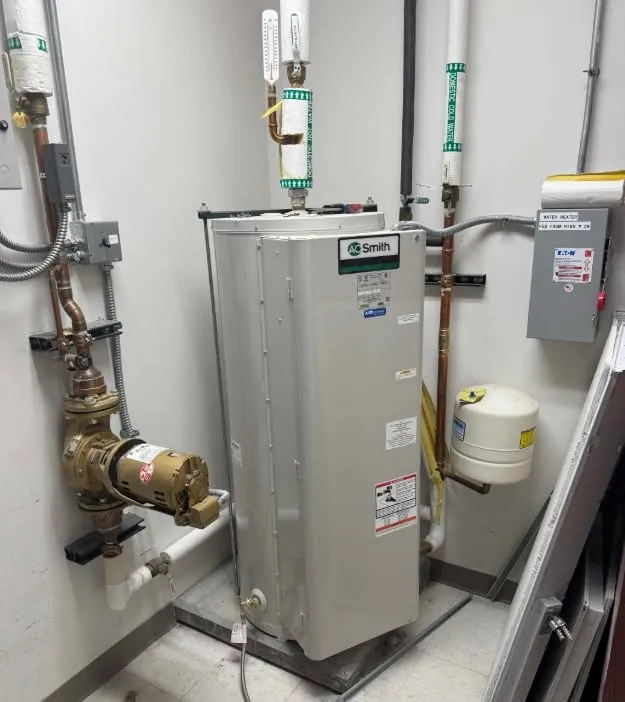
| Water heaters and storage tanks | Low setpoints, sediment in tank bottoms, undersized equipment that can't hold temperature at peak demand | Correct sizing and setpoints, drain-down and flushing on schedule, replacement when a heater can't hold temperature |
| Recirculation loops | Return lines that run cool, unbalanced branches, failed recirc pumps | Balancing valves, pump checks, thermometers or sensors on the return so temperature can actually be logged |
| Mixing valves | Tempered water sitting in long runs at growth-range temperatures | Locating mixing at or near the point of use, testing and maintaining valves |
| Branch piping and dead legs | Capped lines and abandoned fixtures from past remodels holding stagnant water | Cutting dead legs back to the active main instead of capping them in place |
| Rarely used fixtures | Eyewash stations, unused showers, vacant suites | Flushing schedules written into the plan and actually performed |
| Devices | Ice machines, expansion tanks, water filters, hose-type showerheads | Proper connections, backflow protection, and cleaning or replacement intervals |
Every row in that table is a place where the WMP team sets a control limit and someone has to touch the equipment. Cooling towers belong in the plan too, but they're usually handled by the mechanical and water-treatment side, not the plumber.
The scald vs. growth conflict every plan has to settle
Plumbing codes push hot water temperatures down to prevent burns, while Legionella control pushes them up. In St. Charles County, which uses the 2021 International Plumbing Code, Section 607.1.2 requires tempered water to be controlled by an ASSE 1070 device set no higher than 110°F, an ASSE 1017 thermostatic mixing valve, or a heater listed to ASSE 1082 or 1084. Section 607.2 limits how far a fixture can be from a hot water source (50 feet of developed length, with recirculating and heat-traced piping counting as the source).
CDC addresses that conflict directly. It says owners should follow local anti-scald rules, but that state maximums may be too low to limit Legionella growth, and that mixing hot and cold water at or near the point of use can reduce scald risk while letting the water in the pipes stay hot enough to limit growth. In CDC's worked example, the building's heaters are set to 140°F. That's an illustration, not a mandate. The actual setpoints belong to your plan team and engineer, but where mixing happens and how long the tempered runs are are plumbing design decisions.
Renovations and startups: the riskiest weeks
CDC lists system startup, shutdown, renovations, construction, new equipment, equipment failure and water main breaks as moments when monitoring should increase. It also notes that renovations create dead legs and that pressure changes can knock biofilm loose and send it downstream.
The St. Louis Public Schools central office showed how this plays out locally. After the Missouri Department of Health and Senior Services notified the district on May 27, 2026 of an employee's Legionnaires' disease case, testing found Legionella in the building's water and cooling systems, and the building closed June 5. The district had dealt with a burst pipe and water intrusion earlier that spring. Follow-up culture testing found no detectable Legionella in the drinking water and very low levels in a cooling-tower treatment tank. The tank was replaced, the system was flushed and monitored, and the building reopened August 3. The district did not confirm the illness was contracted there.
Nationally, the 2025 Central Harlem cluster in New York City (114 cases, 90 hospitalizations and seven deaths, according to the NYC Health Department) was traced to cooling towers at a hospital and at a nearby construction site.
For GCs and owners, a plan-friendly turnover on a renovation or new build usually includes:
- Removing abandoned branches back to the active main, not capping them in a wall.
- Flushing and disinfecting new potable piping before use. IPC 610.1 spells out the method: 50 ppm chlorine held 24 hours or 200 ppm held 3 hours, or AWWA C651/C652 procedures, then flushed until the chlorine is purged, with the procedure repeated if bacteriological testing shows contamination remains.
- Recording hot water supply and return temperatures at startup so the plan has a baseline.
- Handing over as-builts that show every mixing valve, recirc pump and balancing valve, because those are the plan's control points.
- Planning for the gap between substantial completion and full occupancy, when fixtures sit unused.
Why this keeps coming up
CDC's surveillance data shows reported Legionnaires' disease incidence of 2.90 cases per 100,000 people in 2025 (provisional), up from 2.42 in 2023 and 0.42 in 2000. When CDC reviewed outbreaks from 2015 to 2019, 43% of the buildings had no water management program, and another 40% had one that wasn't being followed. CDC's example of not following a plan is not measuring water heater temperatures. Most of the deficiencies CDC found were process failures, not equipment failures.
Construction activity keeps the issue in front of owners, too. The U.S. Census Bureau's September 2026 construction spending report (released November 2) put total health care construction at about $76.5 billion at a seasonally adjusted annual rate, roughly level with a year earlier. Public health care spending was up 7.5% year over year, while private was down 1.7%. Every one of those projects ends with a startup, a flush and a turnover.
Where a plumbing contractor fits (and where we don't)
Legacy Plumbing doesn't run lab cultures or replace your environmental consultant. Your WMP team owns the risk assessment, sampling and control limits. Our part is the physical work that makes those limits possible to hit and to document: commercial water heater sizing and replacement, recirculation and mixing valve work, removing dead legs during repiping and building rehab, and plumbing for healthcare facilities where patient safety drives the design.
Legacy Plumbing is a union (UA Local 562) commercial plumbing contractor based in O'Fallon, MO, serving St. Louis and St. Charles County since 1996. If your water management team has turned up plumbing items to fix, or you're planning a renovation in an occupied building, call 636-978-0120 (Mon–Fri, 7am–4pm). Night and weekend work is available at higher rates when a shutdown has to happen off-hours.
Frequently asked questions
What is a Legionella water management plan?
It is a written program that identifies where Legionella could grow and spread in a building's water systems, sets control limits such as temperature and disinfectant levels, and documents monitoring and corrective actions. CDC outlines seven steps: build a team, describe the water systems, identify growth and spread areas, set control measures and monitoring, plan interventions when limits are missed, verify the program works, and document everything.
Is a water management plan required for my building?
Medicare-certified hospitals, critical access hospitals and nursing homes are required to have one under CMS memo QSO-17-30. For other buildings, CDC recommends a program for healthcare facilities with overnight patients, buildings primarily housing people over 65, multi-unit buildings with centralized hot water, and buildings over 10 stories, plus devices such as cooling towers, hot tubs and decorative fountains.
What is ASHRAE 188?
ASHRAE Standard 188-2021 sets minimum legionellosis risk management requirements for building water systems in commercial, institutional, multi-unit residential and industrial buildings. It covers design, construction, commissioning, operation, maintenance, repair, replacement and expansion. ASHRAE Guideline 12-2023 provides supporting guidance.
What water temperature does Legionella grow in?
CDC says Legionella grows best between 77°F and 113°F and can still grow outside that range. Setpoints for your building should come from your water management team and engineer, balanced against local anti-scald code requirements.
Does a plumbing contractor test for Legionella?
Sampling and lab testing are typically handled by the water management team or an environmental consultant. A commercial plumbing contractor handles the physical control points: water heaters, mixing valves, recirculation balancing, removing dead legs, and flushing and disinfecting new piping.
Why are renovations a Legionella risk?
CDC notes that renovations can create dead legs where water stagnates, and that construction and pressure changes can dislodge biofilm. CDC recommends increased monitoring during startup, shutdown, renovations, new equipment installation and water main breaks.
Sources
Local
- St. Louis Public Radio, "Legionella bacteria closes St. Louis schools headquarters," Jun 5, 2026: https://www.stlpr.org/news-briefs/2026-06-05/legionella-bacteria-closes-st-louis-schools-headquarters
- St. Louis Public Radio, "St. Louis Public Schools district employee diagnosed with Legionnaires' disease," Jun 8, 2026: https://www.stlpr.org/news-briefs/2026-06-08/st-louis-public-schools-district-employee-diagnosed-with-legionnaires-disease
- St. Louis Public Radio, SLPS testing results, Jun 17, 2026: https://www.stlpr.org/news-briefs/2026-06-17/slps-return-legionella-testing-results
- First Alert 4 (KMOV), Jun 5, 2026 (updated Jun 17): https://www.firstalert4.com/2026/06/05/legionella-found-water-supply-st-louis-public-schools-central-office/
- KSDK, "SLPS central office reopens after Legionella contamination," Aug 3, 2026: https://www.ksdk.com/video/news/education/slps-central-office-reopens-after-legionella-contamination/63-fa3a16bc-23d7-4b70-ad23-2b1a4dd0e398
- 2021 International Plumbing Code (as adopted in Missouri jurisdictions, including St. Charles County), Chapter 6, Sections 607.1.2, 607.2 and 610.1, via UpCodes: https://up.codes/viewer/missouri/ipc-2021/chapter/6/water-supply-and-distribution
National
- CDC, "Developing a Legionella Water Management Program" toolkit (Version 1.2): https://www.cdc.gov/control-legionella/media/pdfs/toolkit.pdf
- CDC, Water Management Program overview: https://www.cdc.gov/control-legionella/php/wmp/
- CDC, Legionnaires' disease surveillance and trends: https://www.cdc.gov/legionella/php/surveillance/
- CDC, Water management gaps in outbreaks, 2015–2019: https://www.cdc.gov/control-legionella/php/data-research/outbreaks-water-management-gaps/
- CMS, QSO-17-30 (revised), Legionella requirements for hospitals, CAHs and long-term care: https://www.cms.gov/medicare/provider-enrollment-and-certification/surveycertificationgeninfo/downloads/qso17-30-hospitalcah-nh-revised-.pdf
- CDC, Federal requirement for healthcare facilities: https://www.cdc.gov/control-legionella/php/healthcare/federal-requirement.html
- ASHRAE, Standard 188-2021 fact sheet: https://www.ashrae.org/file%20library/about/government%20affairs/advocacy%20toolkit/virtual%20packet/standard-188_2021-fact-sheet.pdf
- NYC Health Department, Central Harlem Legionnaires' cluster investigation closed, Aug 29, 2025: https://www.nyc.gov/site/doh/about/press/pr2025/health-department-closes-investigation-central-harlem-legionnaires-cluster.page
- U.S. Census Bureau, Monthly Construction Spending, September 2026 (CB26-176, released Nov 2, 2026): https://www.census.gov/construction/c30/current/index.html
Related services & projects
- Tenant build-out plumbing
- School & education plumbing
- Retail Plumbing in South St. Louis County (St. Louis, South St. Louis County)
- Dental Office Renovation in St. Louis (St. Louis, City of St. Louis)
- Facility Water Heater & Backflow Program (Regional Portfolio)
- Middle School Renovation in St. Charles (St. Charles, MO)
More Resources
- Grease Interceptor vs. Grease Trap: Choosing, Sizing and Placing One on a St. Louis Restaurant Build-Out
Hydromechanical or gravity? How St. Louis City, St. Louis County and St. Charles County codes size grease interceptors, and what to settle before slab cuts.
- Strapped Plumbing and MSD's 2027 Rules: What St. Louis Building Owners and Builders Need to Know
MSD's 2027 draft requires strapped plumbing for basement fixtures in all new buildings. What it is, what's allowed elsewhere, and how to plan for it.
- Mixed-Use Buildings Under MSD's 2027 Rules: Separate Laterals, a Separate Grease Line and Interceptor Basics
MSD's 2027 draft spells out a separate commercial grease line lateral to the interceptor in mixed-use buildings. What changes and how to plan the plumbing.