In March 2025, more than a dozen homes on one street in Green Park, in south St. Louis County, had sewage come up into their basements. The Metropolitan St. Louis Sewer District traced the backup to grease. MSD sent notices of grease interceptor violations to two nearby restaurants. It found interceptors that weren't being maintained, and at one site the public sewer was blocked by grease. MSD told FOX 2 it had inspected those kitchens every two years and would now inspect them quarterly.
Most of that story is about maintenance. But the device itself, its type, size, and location, gets decided long before the first pump-out, on the drawings and during slab work. If a GC gets it wrong at that stage, the owner pays for it for as long as the restaurant is open. This guide covers that early decision for restaurant and food-service build-outs in St. Louis City, St. Louis County, and St. Charles County.
The short answer
A grease trap and a grease interceptor do the same job at different scales. Both slow down kitchen wastewater so fats, oils, and grease (FOG) float to the top and solids settle to the bottom before the water goes to the sewer. In the field, "grease trap" usually means a small hydromechanical unit under a sink or set in the floor. "Grease interceptor" usually means a large gravity tank buried outside. The codes use more precise terms:
- Hydromechanical grease interceptor (HGI): A compact, baffled unit sized by flow rate in gallons per minute. It goes under a sink, in the floor, or just outside the kitchen. It works because of its internal design, not its size, so it needs a vented flow-control device and frequent cleaning.
- Gravity grease interceptor (GGI): A large tank, usually precast concrete or fiberglass and usually buried outside the building. It works because of retention time. Water sits long enough for grease to separate. It's sized by volume and pumped by a vacuum truck.
- Automatic grease removal device (AGRD): An HGI that skims captured grease into a container on its own. It's useful when a kitchen has no room outside for a tank.
The rough split, as Springfield, Missouri's FOG program puts it: hydromechanical units handle flows up to about 100 gallons per minute and can go indoors or out. Gravity units are larger outdoor tanks built for higher flows.
Which code applies depends on the address
This is where St. Louis-area projects trip people up. Three neighboring jurisdictions use two different model codes, and the two codes size interceptors differently.
| Where the building is | Plumbing code in effect | How a gravity interceptor is sized |
|---|---|---|
| City of St. Louis | 2021 Uniform Plumbing Code (Ordinance 71644, effective Feb. 20, 2023) | UPC table based on drainage fixture units (DFU) |
| St. Louis County | 2015 Uniform Plumbing Code with county amendments (Ordinance 27,424, effective Oct. 1, 2019) | UPC table based on DFU; the smallest listed size is 500 gallons for up to 8 DFU |
| Unincorporated St. Charles County | 2021 International Plumbing Code with county amendments | Peak drain flow (gpm) × 30 minutes of retention |
Two cautions. First, St. Louis County's Plumbing Code Review Committee has been working through code chapters in 2025 and 2026, and its June 2025 agenda included Chapter 10, traps and interceptors. Check which edition and amendments are in force on the day you submit. Second, cities inside St. Charles County, including O'Fallon, St. Charles, and St. Peters, run their own building departments. Confirm the code with the city, not the county. Our permits guide explains who issues the permit in each place.
For hydromechanical units, the 2021 IPC requires sizing, testing, and installation to a recognized standard such as ASME A112.14.3 or PDI G101. Its Table 1003.3.5.1 links flow rating to grease capacity: a 50 gpm unit must hold at least 100 pounds of grease, and a 100 gpm unit at least 200 pounds.
MSD sits on top of the plumbing code
Inside MSD's service area, which covers St. Louis City and most of St. Louis County, the sewer district has its own authority. MSD's Sewer Use Ordinance lets it require oil and grease interceptors whenever it decides they're needed. It requires them to be "readily accessible for maintenance and inspection." It also bans degreasers, enzymes, and other products that temporarily emulsify grease, because emulsified grease sets up again downstream in the public sewer. MSD also requires review and approval for any private sewer or drainage work built in the district.
A third agency is involved too. St. Louis County's health department food establishment plan review form asks whether grease traps are provided and where. Make sure your plumbing drawings, your MSD submittal, and your health plan review all show the same device in the same place.
Five decisions to settle before anyone cuts the slab
1. Which fixtures go to the interceptor. The 2021 IPC lists the grease-laden fixtures that must drain through one: pot sinks, prerinse sinks, soup kettles, wok stations, floor drains or sinks that kettles drain into, automatic hood wash units, and dishwashers without a prerinse sink. It also says interceptors should receive waste only from fixtures that discharge grease. Sending restroom waste or clear-water drains through the interceptor makes it bigger and less effective.
2. Where the food waste disposer goes. The IPC says plainly that a food waste disposer can't discharge into a grease interceptor. Ground food fills the tank with solids and cuts its retention time. Menus with heavy prep often use a solids interceptor ahead of the grease interceptor instead. The Crestwood pizza restaurant we plumbed in 2025 used a solids interceptor and an indoor grease interceptor together.
3. Indoor HGI or outdoor GGI. In an existing strip center or second-generation space, an outdoor tank can mean cutting parking lot paving, relocating site utilities, and getting landlord approval. An indoor HGI avoids that work, but it needs more frequent service. If the kitchen expects high flow, a gravity tank may still cost less over the life of the lease.
4. How the pump truck will reach it. The codes require service access, and MSD requires the interceptor to be readily accessible. In practice, that means placing it where a vacuum hose can reach it without crossing the dining room, and setting lids so they can come off without moving equipment. An interceptor nobody can easily reach is the kind that stops getting serviced.
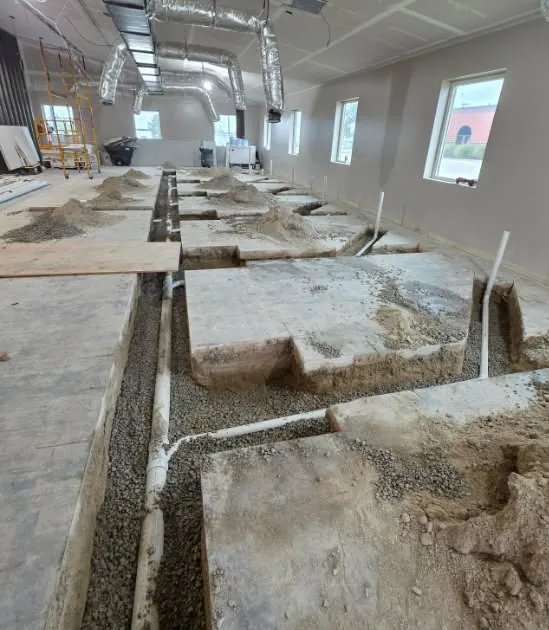
5. The flow-control vent and the slab sequence. The IPC requires a flow-control device on hydromechanical units, vented and ending at least 6 inches above the flood level rim unless the manufacturer's instructions say otherwise. Kitchen drainage is also dense. The Crestwood space alone had 18 floor sinks, 11 area drains, 4 floor drains, and 8 floor cleanouts. Every one of those is a slab cut, so lay out the interceptor, its vent, and its branch lines before the saw shows up, not after.
Why the industry and MSD both care
Grease is a sewer problem nationally, not just a St. Louis one. EPA's report to Congress on sewer overflows found that grease from restaurants, homes, and industry was the most common cause of reported blockages, at 47 percent. EPA estimates that grease trap waste plus uncollected grease ranges from 800 to 17,000 pounds a year per restaurant. Locally, MSD estimates that about 15 percent of blockages in its public sewer system come from FOG. It recommends cleaning interceptors once they reach 60 percent of capacity.
There will be plenty of new kitchens to design. On October 19, 2026, the National Restaurant Association said it still expects restaurant and foodservice sales to grow 4.3 percent in 2026, even after Census benchmark revisions lowered its total sales estimate to $1.36 trillion. Total U.S. construction spending was running at a seasonally adjusted $2.20 trillion annual rate in August 2026, according to the Census Bureau, 0.9 percent above July and 1.7 percent below a year earlier.
Our take
Most grease problems we see started as design shortcuts: an interceptor squeezed under a three-compartment sink because nobody planned for floor space, a disposer tied into the grease line, or an outdoor tank set where a truck can't park. Each one costs more to fix after the restaurant opens than it would have cost to get right on paper.
When we bid a restaurant tenant finish, we confirm the code edition and MSD requirements for the address, mark which fixtures go to the interceptor, and set the interceptor's location before the underground layout is final. After opening, our grease trap and interceptor service keeps the pumping schedule and the paperwork current. You can see a finished kitchen scope on our Crestwood restaurant project. For how MSD's draft 2027 rules treat grease interceptors on mixed-use buildings, see MSD 2027 rules for mixed-use laterals and grease interceptors.
Legacy Plumbing has been a union (UA Local 562) commercial plumbing contractor since 1996, working out of O'Fallon, MO. Send drawings for a written bid, or call 636-978-0120, Monday through Friday, 7am to 4pm.
FAQ
Is a grease trap the same as a grease interceptor?
They do the same thing at different sizes. "Grease trap" usually means a small hydromechanical unit at or near a fixture, sized by gallons per minute. "Grease interceptor" usually means a large gravity tank, often buried outside, sized by volume. Plumbing codes call both grease interceptors and separate them into hydromechanical and gravity types.
How is a gravity grease interceptor sized in St. Louis?
It depends on the jurisdiction. The City of St. Louis (2021 UPC) and St. Louis County (2015 UPC) size gravity interceptors from a table based on drainage fixture units. Unincorporated St. Charles County (2021 IPC) multiplies peak drain flow in gallons per minute by a 30-minute retention time.
Can a garbage disposal drain into a grease interceptor?
No. The International Plumbing Code says a food waste disposer can't discharge to a grease interceptor, because ground food fills the tank with solids. Kitchens with heavy prep often add a solids interceptor ahead of the grease interceptor.
How often does MSD want grease interceptors cleaned?
MSD recommends cleaning when an interceptor reaches 60 percent of capacity. The right frequency depends on how much grease each kitchen produces.
Can enzymes or degreasers replace pumping?
No. MSD's Sewer Use Ordinance bans degreasers, enzymes, and similar products that temporarily emulsify grease in an interceptor, because the grease sets up again farther down the sewer.
Sources (checked Oct 30, 2026)
Local
- MSD Project Clear, "'Just feces everywhere': Residents seek answers after sewer backup destroys basements" (In the News, Mar. 11, 2025): https://msdprojectclear.org/newsroom/in-the-news/residents-seek-answers-after-sewer-backup-destroys-basements/
- FOX 2 St. Louis, "MSD records show potential causes of serious sewer backup" (2025): https://fox2now.com/news/contact-2/msd-records-show-potential-causes-of-sewer-backup-in-st-louis-county-neighborhood/
- MSD Project Clear, Grease Interceptors (60% cleaning guidance; no degreasers or emulsifiers): https://msdprojectclear.org/what-we-do/stormwater-management/help/grease-interceptors/
- MSD Project Clear, Fats, Oils & Grease (about 15% of blockages): https://msdprojectclear.org/customers/problems-tips/healthy-home-tips/grease-management/
- MSD Ordinance 15048, Sewer Use Ordinance (2018), Article VII: https://www.ucitymo.org/DocumentCenter/View/14282/MSD---15048-Sewer-Use-Ordinance-2018
- MSD, General Information about Plan Review of Private Development Projects: https://msdprojectclear.org/wp-content/uploads/2021/09/General_Information.pdf
- City of St. Louis, Ordinance 71644, Uniform Plumbing Code 2021 Edition: https://www.stlouis-mo.gov/government/city-laws/ordinances/ordinance.cfm?ord=71644
- St. Louis County, Plumbing Code Notice, Ordinance 27,424 (2015 UPC): https://stlouiscountymo.gov/st-louis-county-departments/transportation-and-public-works/codes-and-ordinances/2019-plumbing-code/
- St. Louis County, Historical Plumbing Code (effective date Oct. 1, 2019): https://stlouiscountymo.gov/st-louis-county-departments/transportation-and-public-works/codes-and-ordinances/historical-plumbing-code/
- St. Louis County Plumbing Code Review Committee, June 10, 2025 agenda (Chapter 10: Traps and Interceptors): https://stlouisco.civicweb.net/document/403520/
- St. Louis County Department of Public Health, Food Establishment Plan Review: https://stlouiscountymo.gov/st-louis-county-departments/public-health/food-and-restaurants/permit-applications/food-establishment-plan-review-application/
- St. Charles County, Building and Construction Codes (2021 I-Codes incl. 2021 St. Charles County Plumbing Code): https://www.sccmo.org/209/Building-and-Construction-Codes
- City of Springfield, MO, FOG Management Plan (HGI vs. GGI flow ranges): https://www.springfieldmo.gov/DocumentCenter/View/69414/FOG--Mgmt-Plan_2020
- Legacy Plumbing, Restaurant Plumbing in Crestwood (project page): /projects/restaurant-plumbing-crestwood-mo
National
- International Plumbing Code 2021, Chapter 10 (Sections 1003.3.1, 1003.3.2, 1003.3.5, Table 1003.3.5.1, 1003.3.5.2, 1003.3.7, 1003.10), via UpCodes: https://up.codes/viewer/missouri/ipc-2021/chapter/10/traps-interceptors-and-separators
- IAPMO Uniform Plumbing Code 2015, Table 1014.3.6, Gravity Grease Interceptor Sizing, via UpCodes: https://up.codes/s/sizing-criteria
- U.S. EPA, National Pretreatment Program: Controlling FOG Discharges from Food Service Establishments (47% of blockages; 800–17,000 lb/yr per restaurant): https://www.epa.gov/system/files/documents/2021-07/pretreatment_foodservice_fs.pdf
- National Restaurant Association, "Restaurant sales volume revised lower based on benchmarked government data" (Oct. 19, 2026): https://restaurant.org/research-and-media/research/restaurant-economic-insights/analysis-commentary/restaurant-sales-volume-revised-lower-based-on-benchmarked-government-data/
- U.S. Census Bureau, Monthly Construction Spending, August 2026 (CB26-158, Oct. 1, 2026): https://www.census.gov/construction/c30/pdf/release.pdf
Related services & projects
Talk to a St. Louis commercial plumber
Send drawings for a written bid, or call 636-978-0120, Monday through Friday, 7am to 4pm.
More Resources
- Legionella Water Management Plans: The Plumbing Side, Explained for St. Louis Facility Teams
What a Legionella water management plan covers, who needs one, and the plumbing work behind it: water heaters, mixing valves, recirc loops and dead legs.
- Strapped Plumbing and MSD's 2027 Rules: What St. Louis Building Owners and Builders Need to Know
MSD's 2027 draft requires strapped plumbing for basement fixtures in all new buildings. What it is, what's allowed elsewhere, and how to plan for it.
- Mixed-Use Buildings Under MSD's 2027 Rules: Separate Laterals, a Separate Grease Line and Interceptor Basics
MSD's 2027 draft spells out a separate commercial grease line lateral to the interceptor in mixed-use buildings. What changes and how to plan the plumbing.